
What Are Digital Ads: Boosting Small Business Trust
Struggling to stand out online while keeping a tight budget is a daily reality for many small business owners. Understanding the essentials with digital ads let you reach your ideal customers without wasting money. This guide clears up common misconceptions, explains the types of ads available, and offers practical strategies to help you grow your business with confidence.
Common Sense Marketing Team


Table of Contents
Digital Ads Defined: Essentials and Misconceptions
Types of Digital Ads and Their Unique Roles
How Digital Ads Work for Small Businesses
Maximizing Business Growth with Digital Ads
Risks, Costs, and Common Pitfalls to Avoid
Key Takeaways
Digital Advertising is Accessible: Small business owners can successfully utilize digital ads without massive budgets or complex technology. Targeting the right audience is key to maximizing efficiency.
Multiple Ad Types Serve Different Goals: Understand the unique roles of ad types such as search, social media, and video ads to optimize your marketing strategy. Each type should align with your objectives.
Continuous Improvement is Essential: Small businesses can leverage actionable data from digital ads to refine strategies and maximize growth. Monitoring performance enables quick adjustments.
Transparency Builds Trust: Being honest about data collection and ad placements fosters customer trust and relationship-building, which are crucial for repeat business.
Digital Ads Defined: Essentials and Misconceptions
Digital advertising is the practice of promoting products, services, or brands through online channels and technologies. Unlike traditional advertising that relies on print, television, or radio, digital ads reach audiences across websites, social media platforms, search engines, and mobile apps. The key advantage is real-time measurement. You can see exactly how many people viewed your ad, clicked it, and took action. This precision makes it far easier for small business owners to understand what's working and adjust spending accordingly.
The confusion around digital ads often stems from misconceptions about what they are and how they work. Many small business owners assume digital advertising means massive budgets and complex technology they can't understand. That's simply not true. Digital ads range from simple sponsored posts on Facebook to search ads on Google. You don't need to be a tech expert to run them. Another common misconception is that digital ads work instantly. They don't. Building visibility and trust takes consistent effort over weeks and months, not days. Additionally, many business owners believe digital advertising automatically drives sales, but the reality is that ads work best when paired with clear messaging and genuine value. If your ad promises something your business doesn't deliver, you'll burn money and damage trust.
What makes digital ads particularly powerful for small businesses is targeting. You can show your ads specifically to people in your area, people interested in your type of service, or people who've visited your website before. You're not paying to reach everyone. You're paying to reach the right people. Another critical element is transparency and authenticity. Ethical concerns around data privacy and transparency are increasingly important to consumers. Small businesses that are honest about how they collect and use customer data build stronger relationships than those cutting corners. When you run ads with real claims and genuine offers, customers notice. They trust you more. That trust translates to repeat business and referrals.
The bottom line is this: digital ads are a tool for reaching the right people with the right message at the right time. They're not magic, and they're not complicated. When done right with a practical strategy, they help small business owners build visibility and earn customer trust without overspending.
Pro tip: Start with one clear, honest message in your ads rather than trying to say everything at once. Customers trust businesses that know what they do and communicate it clearly.
Types of Digital Ads and Their Unique Roles
Not all digital ads are created equal. Different types serve different purposes in your marketing strategy, and understanding what each one does helps you spend your budget wisely. Search ads appear when someone actively types what they're looking for into Google or another search engine. They capture high-intent customers at the exact moment they're searching for your solution. Social media ads show up in Facebook, Instagram, LinkedIn, and other platforms where people spend their downtime. These work differently because people aren't searching for solutions. They're scrolling through content. Social media ads interrupt that scrolling with something relevant enough to catch attention. Display ads are the banner ads you see on websites as you browse. They build awareness and keep your business top-of-mind. Video ads play before or during YouTube videos and streaming content. They tell a story visually and tend to stick in people's minds better than static images.


Each ad type has its own pricing model and goal. Search ads and social media ads differ in pricing structure, with search typically using cost-per-click models while social media might use cost-per-thousand-impressions. For small business owners, this matters because it affects how you budget and measure results. Search ads work best when you want immediate conversions. Someone searches for "plumber near me" and your search ad appears. That's a hot lead. Social media ads work better for building awareness and trust over time. Video ads fall somewhere in between, strong for engagement and storytelling. Native advertising and content ads blend promotional material with regular content, making them feel less like ads and more like genuine recommendations. This approach builds trust because it doesn't feel pushy.
Here's a side-by-side look at common digital ad types, their main goal, and when to prioritize each:
Search Ads: Capture active intent. Services people search for often.
Social Media: Build brand awareness. Visual, lifestyle, or local brands.
Display Ads: Maintain top-of-mind. Broad exposure to web audiences.
Video Ads: Engage and tell a story. Complex messages or product demos.
Native/Content: Build trust and educate. Subtle, value-driven promotion.
The right mix depends on your business goals and what your customers actually need. A dentist might lean heavily on search ads because people actively look for dental services. A clothing brand might prioritize Instagram and Pinterest where people discover new styles. A consulting firm might use LinkedIn ads to reach business decision-makers. The key is matching the ad type to where your customers are and what they're ready to hear. Many small business owners make the mistake of spreading their budget across every platform equally. That's like fishing in every pond with the same rod and bait. Instead, test one or two channels where your specific customers hang out. Measure results. Double down on what works.
Pro tip: Start with search ads if people actively search for your service, or social media ads if you need to build brand awareness first, but don't run both simultaneously until you understand which performs better for your specific business.
How Digital Ads Work for Small Businesses
Digital ads work by placing your message in front of the right people at the right time, then tracking what happens next. Here's the basic process. You create an ad with text, images, or video. You decide who should see it (people in your area, people interested in certain topics, people who've visited your website). You set a budget. The platform then shows your ad to those people as they browse online. When someone clicks your ad or takes action like making a purchase, you get data about what worked. This feedback loop is what separates digital ads from traditional advertising. With a newspaper ad, you never know who actually saw it or what they did afterward. With digital ads, you know almost everything.
Small businesses benefit from this transparency and precision because you don't waste money reaching the wrong audience. Digital marketing strategies including online advertising increase SME market presence and help businesses compete effectively even with limited budgets. Instead of paying to reach everyone in a city, you pay to reach people actively looking for your service or people matching your ideal customer profile. A plumber in Denver doesn't pay to show ads to people in California. A personal trainer can show ads only to people within five miles of their studio. A wedding photographer can target engaged couples in their service area. This targeting means your ad spend goes further. You're not burning money on irrelevant viewers.
The real power comes from what happens after the click. Digital ads generate actionable data that helps you understand your customers better. You see which ads get clicked most, which ones lead to actual sales, how long people spend on your website, and what pages they visit. You learn whether a photo of your team works better than a photo of your product. You discover that Tuesday ads perform better than Friday ads. You find out that customers aged 35 to 50 convert more reliably than younger audiences. All this information feeds back into your strategy. You stop running ads that don't work. You spend more on ads that do. You test new messages based on what you learn. This constant improvement is how small businesses build sustainable growth without massive budgets.
Another critical advantage is speed. If a local restaurant runs a newspaper ad promoting a holiday special, they can't change it for weeks. With digital ads, you can pause an underperforming ad and launch a new one in minutes. You can test five different messages in a week. You can pivot quickly when you learn something new about your customers. This agility gives small business owners an edge they never had before. You're not locked into expensive long-term commitments. You can test, measure, adjust, and scale what works. Converting leads into customers requires understanding your audience's journey, and digital ads provide the data you need to optimize that journey at every stage.
Pro tip: Track one key metric that matters most to your business, like website visits, phone calls, or sales, and adjust your ad strategy weekly based on that metric instead of constantly changing tactics.
Maximizing Business Growth with Digital Ads
Growth doesn't happen by accident. It happens when you reach the right customers with the right message at the right time, consistently. Digital ads are one of the most direct paths to that growth, especially for small business owners competing against larger companies. Here's why. Traditional advertising spreads your budget thin across mass audiences. Digital ads concentrate your budget on people most likely to buy from you. A study found that 86% of European SMBs attribute revenue growth to personalized digital ads. That's not coincidence. That's the result of precision targeting and continuous optimization. When you show personalized ads to the right person at the right moment, they're far more likely to convert into paying customers.
Growth compounds when you combine multiple digital strategies together. A well-integrated approach using search ads, social media advertising, content marketing, and email campaigns significantly improves customer acquisition, engagement, and conversion rates. Think of it like this. Search ads catch people actively looking for solutions. Social media ads build awareness with people not yet searching. Content attracts people researching their options. Email stays in touch with people who visited your website. Each channel serves a purpose. Together, they create multiple touchpoints that guide customers toward buying from you rather than your competitors. A customer might see your social media ad on Monday, search for your service on Wednesday and click your search ad, visit your website and read your blog on Thursday, then receive an email on Friday that closes the sale. Without all those touchpoints, they might have chosen a competitor instead.
The growth multiplier effect kicks in when you measure what works and double down on it. Many small business owners run ads passively, hoping something sticks. That's not strategy. That's gambling. Real growth comes from testing different ads, measuring which ones produce results, and spending more budget on winners. If one ad generates sales at half the cost of another, you shift your budget to the winning ad. If a specific audience segment converts better than others, you expand that audience targeting. Consistent posting and strategic content frequency compound your ad effectiveness by giving people multiple reasons to trust and remember your business. You're not just running one ad and hoping it works. You're building a system that continuously improves through data and iteration.
Speed is another growth advantage digital ads provide. You can test new markets or new customer segments quickly without major investment. A locksmith in Denver can test ads in a neighboring suburb to see if expansion is worth it. A service provider can test a new offer to a different age group. A product seller can experiment with new messaging. All with small budgets and clear feedback on what works. If the test succeeds, you scale it up. If it fails, you pause it and try something else. This agility means small businesses can respond to opportunities faster than their larger competitors with rigid marketing budgets.
Pro tip: Focus on one growth metric that aligns with your business goal for the first three months, whether that's leads, sales, or website traffic, and measure everything against that single metric to avoid scattered efforts.
Risks, Costs, and Common Pitfalls to Avoid
Digital ads aren't risk-free. Money can disappear fast if you don't know what you're doing. The biggest mistake small business owners make is assuming that running ads automatically generates sales. That assumption leads to wasted budgets and frustration. Ads are only as good as your offer, your messaging, and your follow-up. If your website is confusing, your offer unclear, or your customer service poor, ads will just amplify those problems to more people. You'll spend money bringing people to a broken experience. Another common pitfall is spreading your budget too thin. Running small ads across five different platforms means you're not spending enough on any single platform to get meaningful results. You need concentration of force. Pick one or two platforms where your customers actually are and dominate there before expanding.
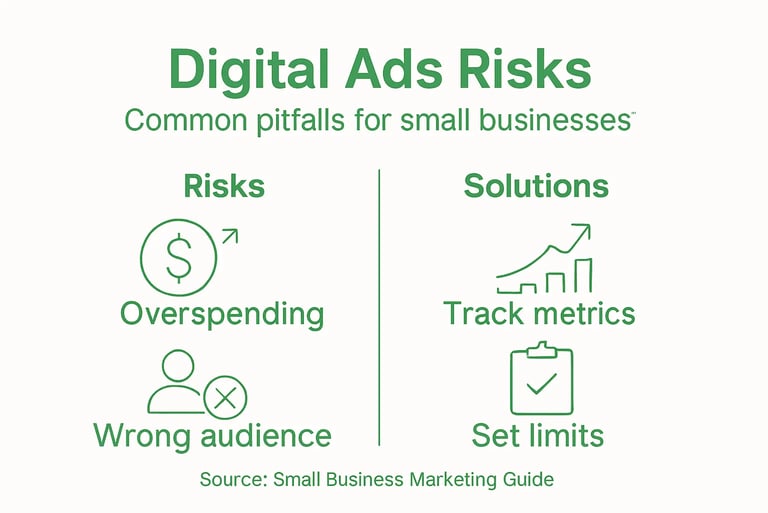
Costs escalate quickly when you don't monitor performance. Many small business owners set up an ad campaign, launch it, and forget about it for a month. Meanwhile, they're paying for clicks from people who will never buy. The algorithm keeps spending money on whatever generates the most clicks, even if those clicks don't convert to customers. You need to check your ads at least weekly. Look at which ones drive actual results versus which ones just look busy. Ethical concerns around ad fraud, privacy, and transparent data use directly impact your bottom line because fraudulent clicks waste your budget without delivering real customers. Bad actors create fake traffic that inflates your costs. Always verify that the traffic you're paying for comes from real people in your target location.
Brand safety is another often overlooked risk. Your ads can appear next to content that doesn't represent your business well. A family-oriented business might find their ads running next to controversial content or misinformation. This damages your brand reputation and customer trust. Set strict controls on where your ads appear. Review the placements regularly. Don't just accept whatever the algorithm suggests. You're paying for this visibility, so you get to be selective about where your brand appears. Privacy concerns are increasingly important to customers. Be transparent about how you collect and use customer data. If you're retargeting ads to people who visited your website, they should know it. If you're using their information for marketing, tell them. Customers trust businesses that are honest about data use far more than businesses that seem sneaky.
The cost trap happens when you optimize for the wrong metric. Some platforms make it easy to get cheap clicks that look impressive in reporting but never convert to customers. You might see 1,000 clicks for $100 and think you're winning. But if zero of those clicks lead to sales, you just burned $100. Optimize for business results, not vanity metrics. Track phone calls, form submissions, or actual purchases. Track website visitors who spend real time on your site, not people who click and bounce immediately. Know your customer acquisition cost for your business and stop running ads that cost more than that to acquire a customer.
This table summarizes key risks in digital advertising and strategies to minimize them:
Ad Spend Waste: Budget depleted, low ROI. Monitor performance weekly.
Ad Fraud: Paying for fake clicks or views. Track real conversions, use filters.
Brand Safety Issues: Damaged reputation, lost trust. Exclude sensitive placements.
Privacy Concerns: Loss of customer confidence. Communicate transparent data use.
Vanity Metrics: Misleading performance insights. Focus on cost per acquisition.
Pro tip: Set a weekly review schedule to check which ads drive actual business results, and pause underperforming ads immediately instead of waiting for a full month to pass before evaluating.
Unlock the True Power of Digital Ads for Your Small Business
The article highlights common challenges small business owners face with digital advertising including wasted budgets on ineffective ads, unclear messaging, and difficulty targeting the right audience. You want to build consistent trust and visibility but might feel overwhelmed by platforms, metrics, and confusing tech jargon. If you are looking for practical solutions that make digital advertising simple, transparent, and genuinely effective, you are in the right place. Terms like "targeting," "cost per acquisition," and "brand safety" are key concepts you need to master — and we help you do that with ease.
At CSM Team, we specialize in helping small and local businesses turn digital ads and social media strategies into clear, trust-building opportunities that actually make sense. Our month-to-month, no-contract approach means you get expert guidance without long-term risk or setup fees. We manage everything done for you so you can focus on running your business while we create ads and content that reach the right people at the right time. This laser focus avoids wasted spend and prevents the common pitfalls mentioned in the article.
Take control of your digital marketing results today and stop guessing what works.
Explore how our practical services blend targeted digital ads with authentic messaging for sustainable growth at CSM Team. Ready to boost your business trust and visibility the smart way? Visit our homepage now and get started with a partner who truly understands your needs. Let us take the complexity out of digital advertising so you can win the customers you deserve.
Frequently Asked Questions
What are digital ads and how do they work?
Digital ads are promotional messages placed on online channels like websites, social media, and search engines. They work by targeting specific audiences based on their interests, behaviors, and locations, allowing businesses to measure engagement and conversions in real-time.
How can digital ads help small businesses build trust?
Digital ads can help build trust by using clear messaging, offering genuine value, and being transparent about data usage. Honest advertisements resonate better with customers, leading to stronger relationships and repeat business.
What types of digital ads are most effective for small businesses?
Effective types of digital ads include search ads for capturing immediate intent, social media ads for building brand awareness, and video ads for engagement. The best choice depends on your business goals and the behaviors of your target customers.
How can I measure the success of my digital ad campaigns?
You can measure success by tracking key performance metrics like website visits, conversion rates, and return on ad spend. It's important to monitor these metrics regularly and adjust your strategy based on what works best for your business.
"Smooth, simple, and surprisingly fast."
Trevor C.
★★★★★
Ready To Love Social Media?
Join all of the successful brands who've run their social media presence with common sense marketing.
hello@csmteam.ca
PO Box 7 Stn A
Nanaimo, BC V9R5K4
1.833.CSM.TEAM

Insightful Blogs
Post Examples
Client Dashboard
Community Support
Other Stuff
Let's Talk
Fun Stuff